Given an index k, return the kth row of the Pascal's triangle.
For example, given k = 3,
Return
Return
[1,3,3,1].
Note:
Could you optimize your algorithm to use only O(k) extra space?
Hint: This is a follow-up question of pascal triangle. An obvious method is to just compute every row of that triangle, and select the k-th row, However, as it is suggested to optimize the algorithm by using only O(k) extra space, we should not do like that.Could you optimize your algorithm to use only O(k) extra space?
There is an interesting property of Pascal's Triangle, as shown here
http://en.wikipedia.org/wiki/Pascal%27s_triangle
which indicates that the k-th element of the n-th row in the triangle is given by C_n^k. Then the solution is obvious.
However, a difficulty is how to calculate C_n^k. As factorial operations may result in overflow, we use a safer way to get the value, as
C_n^k=C_{n-1}^{k-1}*n/k
shown from line 20-line 21
shown from line 20-line 21
Also, as the combination numbers are symmetric, we just calculate half of the values, shown in line 23
01 public ArrayList<Integer> getRow(int rowIndex) {
02 ArrayList<Integer> row=new ArrayList<Integer>();
03 for(int i=0;i<=rowIndex;i++)
04 {
05 int value=(int) combination(rowIndex,i);
06 row.add(value);
07 }
08 return row;
09 }
10
11 //calculate C_n^k
12 public long combination(int n, int k)
13 {
14 if(k==0 || k==n)
15 return 1;
16 if(k==1 || k==n - 1)
17 return n;
18 //Just calculate the left half,
19 //as the combination numbers are symmetric
20 if(k<=(n + 1) / 2)
21 return combination(n - 1,k - 1) * n / k;
22 else
23 return combination(n, n - k);
24
25 }
C_n^k=C_{n-1}^k+C_{n-1}^{k-1}
Look familiar, right?
Remember the Fibonacci number we have met before. To calculate the next number, we add up previous two numbers. Look at the following figure
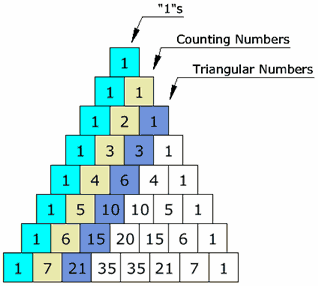
At the 0-th line, we only have one variable 1.
At the 1-st line, we have two variables x and y both set to 1.
At the 2-nd line, x is substitute by y, and y is substitute by the 1-th element in the arraylist, which was 1 previously (yellow 1 at the 1-th row). Then we update it as (x+y) and we get 2. Then we simply push "1" as the last element.
At the 3-rd line, x is substitute by y, which is 1, and y is the 1-st element of the array, which is the yellow 2, we update it to (x+y), which is the yellow three. Then x is substitute by y, which equals 2, and y is the 2-nd element (blue 1), then we get (x+y) and update the 2-nd element, which results the blue 3. In the end we just append 1.
...
01 public ArrayList<Integer> getRow(int rowIndex) {
02 ArrayList<Integer> row=new ArrayList<Integer>();
03 row.add(1);
04 if(rowIndex==0)
05 return row;
06 row.add(1);
07 if(rowIndex==1)
08 return row;
09 for(int i=2;i<=rowIndex;i++)
10 {
11 int x=1;
12 int y=1;
13 for(int j=1;j<i;j++)
14 {
15 x=y;
16 y=row.get(j);
17 row.set(j,x+y);
18 }
19 row.add(1);
20 }
21 return row;
22 }
02 ArrayList<Integer> row=new ArrayList<Integer>();
03 row.add(1);
04 if(rowIndex==0)
05 return row;
06 row.add(1);
07 if(rowIndex==1)
08 return row;
09 for(int i=2;i<=rowIndex;i++)
10 {
11 int x=1;
12 int y=1;
13 for(int j=1;j<i;j++)
14 {
15 x=y;
16 y=row.get(j);
17 row.set(j,x+y);
18 }
19 row.add(1);
20 }
21 return row;
22 }

没有评论:
发表评论